
Oral rehabilitation (prosthodontics) is the field that gives the mouth back what it has lost: missing teeth, worn or broken teeth, a collapsed bite, a denture that does not work. It starts by planning the mouth as a system — bone, gums, teeth, jaw joints and chewing muscles — and continues with the tools: crowns, bridges, implants, dentures. The goal: eat everything, speak clearly, and smile without thinking about it.
The solutions
Implant overdenture
A removable denture that locks onto 2–4 implants — stable, does not move, comes out for cleaning.
Complex rehabilitation
When many problems come at once: wear, missing teeth, a low bite. Planning everything together.
How we start
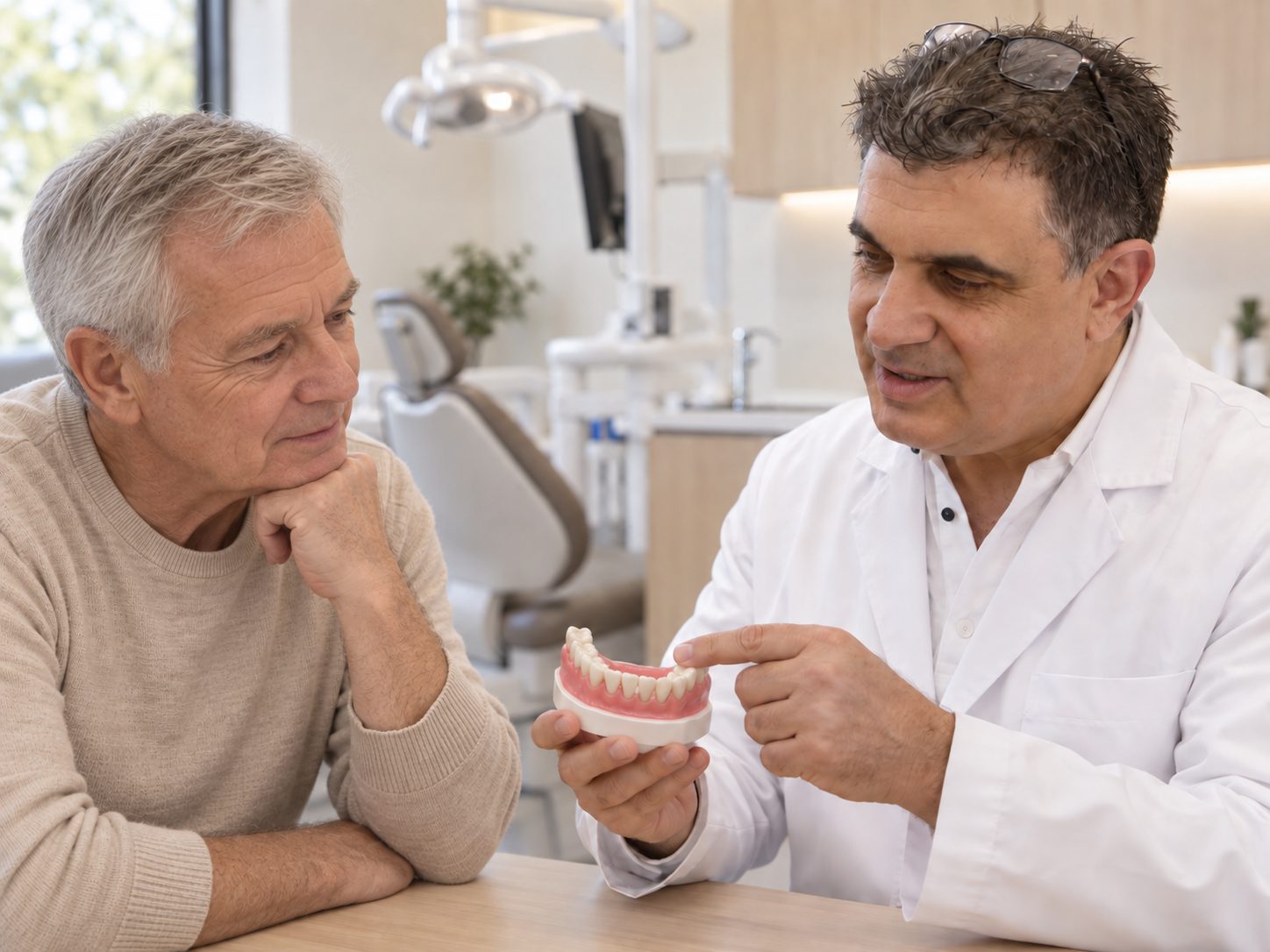
By listening. What really bothers you, what you have tried, what you want to eat — that sets the direction more than any scan. Then diagnosis: exam, X-rays, digital scan, photographs of the face and smile. The plan is shown to you on screen before a tooth is touched.
And the rule we do not bend: provisionals first. We test chewing, speech and appearance with them, fix what needs fixing, and only then make the permanent restoration — an exact copy of what you approved.
A permanent restoration without a provisional stage is a gamble. We do not gamble with your mouth, even when it adds two weeks.
Frequently asked questions
Implant overdenture or fixed bridge — which is better?
A fixed bridge feels closest to natural teeth. An implant overdenture costs less, needs fewer implants and less bone, supports the lips well and comes out for cleaning. For many people it is the right solution. We decide together based on the mouth, habits and budget.
Zirconia or porcelain?
Monolithic zirconia — the strongest, for molars and bridges. Porcelain on zirconia — the most aesthetic, for the smile zone. E.max — for single front crowns. Usually we combine by area.
How long does full-mouth rehabilitation take?
Without implants — a few weeks. With implants — 4–9 months, and with bone grafts up to a year. Throughout, you have functioning provisional teeth.
My teeth are worn from grinding. What can be done?
A rehabilitation that restores bite height and tooth length — crowns or veneers — together with a night guard that protects the result. Everything is tested in provisionals before the permanent restoration.
How many visits is a full-mouth rehabilitation?
Without implants: 6–8 visits over one or two months. With implants you add the surgery and the healing months, but the number of visits itself does not grow much. Most are short — the long ones are the surgery and the try-in of the provisionals.
Can the bite be raised without touching every tooth?
Sometimes — with crowns or onlays on the back teeth only, and the front teeth adjusted with light reshaping. It depends on how much has worn and where. When it is a little, a partial solution. When the face has already “shortened”, it is the whole mouth, and there is no way around it.
Do the provisionals look good, or am I walking around “under construction”?
Our provisionals are your new teeth in a test version: same shape, same shade, different material. People go to weddings in them. That is what they are for — to test in real life before copying to zirconia.
How does this work alongside my regular dentist?
Well. We do the rehabilitation; your family dentist carries on with cleanings, fillings and whatever is outside our field. We send them a summary letter with the implant passport, and if they want, we talk to them directly.
Want to know if immediate loading is right for you?
A first consultation at any network clinic includes an exam, a reading of your scan and an explanation of the options — no obligation.