
The process has five stages: consultation and exam (one visit), digital planning (without you present), treatment day (one long visit), a supervised healing period (3–6 months with 3–4 short check-ups), and the permanent restoration (2–3 visits). The team at the clinic you chose accompanies you at every stage; complex cases are planned and followed by the network’s medical director.
1 · Consultation and exam — about 45 minutes
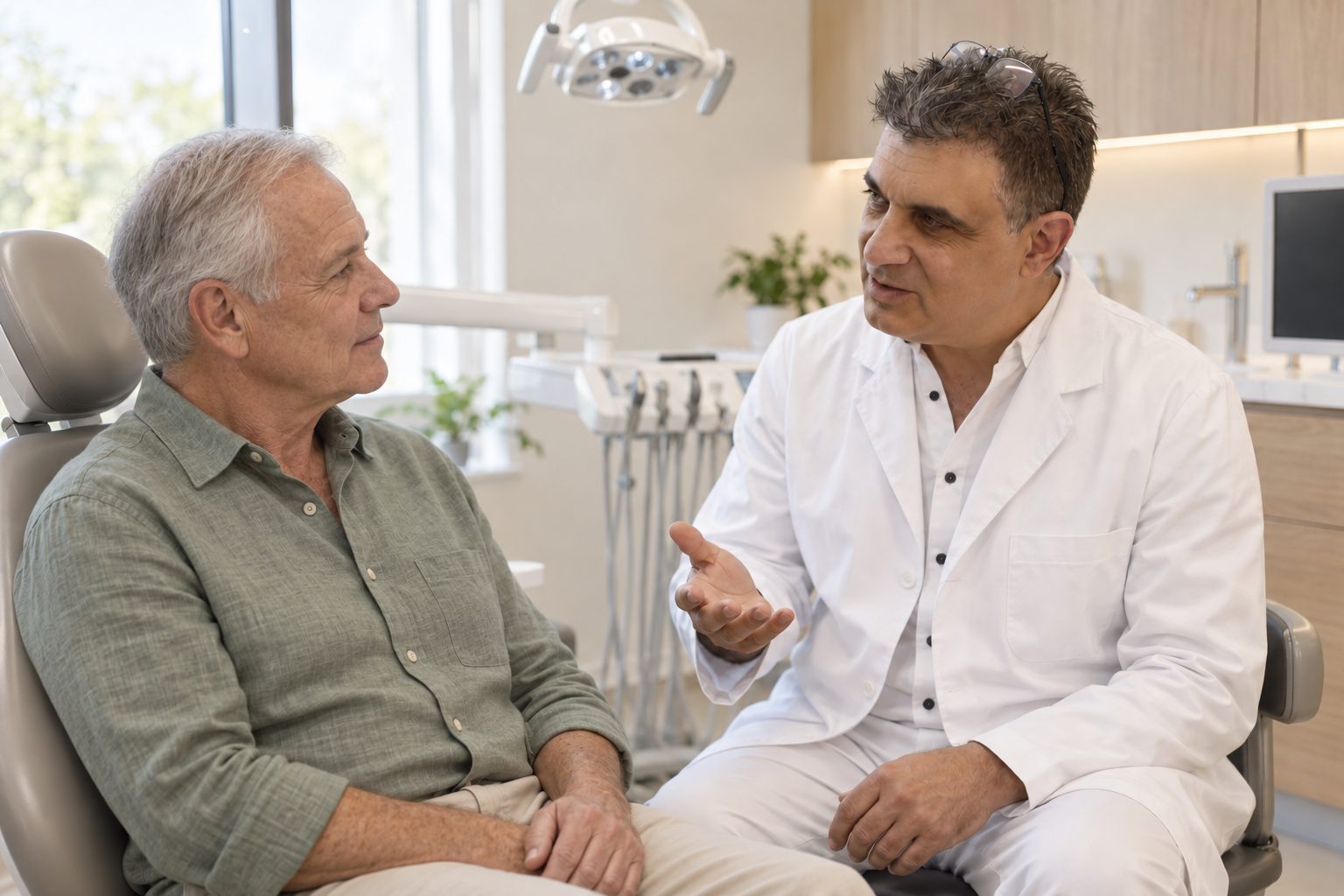
We start with a conversation: what bothers you, what you have tried, what matters to you — eating a steak? no longer feeling embarrassed? getting rid of the denture? Then a clinical exam, a reading of your 3D CT scan (an existing one, or a referral to an imaging centre before the visit), a health questionnaire and photographs. By the end you get an explanation of the options that suit you, what each includes, a timeline and a detailed quote. No pressure to decide on the spot.
2 · Digital planning
The CT and the digital scan merge into a 3D model. On it the implants are planned relative to the bone, nerves and sinuses — and to the teeth that will be built on them. From the plan a surgical guide and the provisional bridge are printed. In a short meeting (or video call) you see the plan and approve tooth shape and shade.
3 · Treatment day
Come after a meal, with a companion. Local anaesthesia (sedation if needed). Extractions if teeth remain, implant placement through the guide, stability measurement, and fitting of the provisional bridge. Duration: 2–4 hours per jaw. You go home with teeth, written instructions, prescriptions and a direct phone number.
4 · Supervised healing — 3 to 6 months
| When | What |
|---|---|
| Days 1–3 | Swelling, discomfort. Painkillers, cold, soft cool food. Rest. |
| One week | First check-up, stitches out if any. Most people are back to routine. |
| One month | Check-up. Soft-to-medium diet. Cleaning as instructed. |
| 3 months | Osseointegration check. In the lower jaw the permanent stage can usually start. |
| 4–6 months | In the upper jaw. Scan for the permanent bridge. |
5 · The permanent restoration — 2 to 3 visits
A digital scan of the implants, a try-in of the bridge (shape, shade, bite, speech) and adjustments until you are happy. The permanent bridge — zirconia or hybrid — is screwed in and balanced. You receive cleaning instructions, a night guard if needed, and a check-up plan: once a year an exam and professional cleaning.
Frequently asked questions
When can I go back to work?
Most patients after 2–4 days. Strenuous physical work — after a week. Swelling peaks on day two or three and then subsides.
How do I clean a bridge on implants?
A regular or electric toothbrush, an interdental brush or a water flosser (Waterpik) under the bridge once a day, and professional cleaning at the clinic once a year. You get hands-on instruction.
What if something breaks on the provisional bridge?
Call and come in — the repair is usually quick and same-day. The provisional bridge is designed to absorb exactly that; which is why you do not bite hard things during this period.
How many check-ups are there after surgery?
After one week, one month and three months — then the scan for the permanent bridge. After the permanent: an exam and cleaning once a year. You can call at any stage.
Is there a warranty?
Yes — on the implants and the restoration, provided check-ups and hygiene are kept. Full details are in the quote and the treatment agreement, in writing.
What do I eat on the evening after surgery?
Something soft and cold: yoghurt, pudding, mashed potato, avocado, a smoothie. Not hot, not spicy, not through a straw (the suction disturbs clotting). The next day, soft pasta and eggs. Within a week — anything you do not have to bite into.
May I smoke after surgery?
Better not for at least two weeks, and a month if you can. Smoking in the first two days is the most common reason for a wound infection and an implant that does not integrate. If you know you will not manage, tell us beforehand — there are things we can do about it.
My face is swollen on day three. Is that normal?
Yes — that is exactly the peak. Swelling rises for 48–72 hours and then goes down. Cold on day one, warmth from day three, sleep with your head raised. What is not normal: a fever above 38, swelling that grows after day four, or a bad taste that does not go away — then you call, you do not wait for the check-up.
Do I need to come for the check-up if everything is fine?
Yes. The one-week and one-month check-ups look for things you cannot feel — a loosened screw, a pressure point on the bridge, gum that is not closing. Five minutes that save an hour of repair. And anyone who skips the check-ups is not covered by the warranty; it is in the agreement.
Want to know if immediate loading is right for you?
A first consultation at any network clinic includes an exam, a reading of your scan and an explanation of the options — no obligation.